Two days later, here is where it stands: the sweep is done, the app has its own home at macdeficit.com, it has a price, and what's left between it and you isn't code. It starts with Apple.
We hope that means days, not weeks.
The sweep held
In The session where nothing changed we said we wouldn't call the audit done until the sweep was. Session 50 was the sweep.
We went back over the whole code base once more: the scanner, the bridge, the Mac app, the build. Everything Session 36 had found was checked closed, and everything the fixes had left behind was cleaned up. It still found things, which is the point of doing it. A drive formatted for Windows (FAT) looked empty, because macOS reports its files as taking no space; it now matches what Finder says. Cancelling a scan in the middle of a huge folder, like a browser's cache, could take a few seconds to land; now it takes a fraction of one. Clicking something in the list or the apple now hands it the keyboard, so ⌘⌫ and the arrow keys act on what you clicked. And ⌘Z in the search field undoes your typing, not your last trip to the Trash.
Then Claude drove the app through the whole checklist, click by click, with Jer watching. Every item passed.
The audit is closed. We'd rather have the four days it took than a launch with those five things inside it.
How it goes out
Session 51 was the conversation we'd been putting off: how does a small Mac app actually reach people? We did the reading first, with sources, and then made the calls.
It's sold from our own site, as a direct download. One payment, yours to keep. No account, no subscription.
It's signed with Apple's Developer ID and notarized. That means Apple has checked it, and your Mac opens it without a warning. One script now does all of it: builds the release, signs it, sends it to Apple, staples Apple's answer to it, packs the disk image and writes its checksum.
It checks for updates only when you ask. Mac Deficit › Check for Updates… reads one small file from our site that holds the newest version's number, and nothing else. It sends nothing about you, your Mac or your files, it never checks on its own, and it downloads and installs nothing. When we tested it against the live site this morning, the server's log saw the name "MacDeficit" and that was all.
The App Store edition comes after. It's built and waiting; the direct download goes first.
One thing has changed since our last post, and we said we'd be honest about the plan. The company is still coming: an LLC to own what RawData makes. But forming one takes time, and we said we wouldn't hold the app behind it. So Jer enrolled with Apple as an individual, and the app moves to the company once it exists.
A home of its own
Session 52 started with Jer's words: "still waiting on apple." So we built the thing we'd need the moment Apple answered.
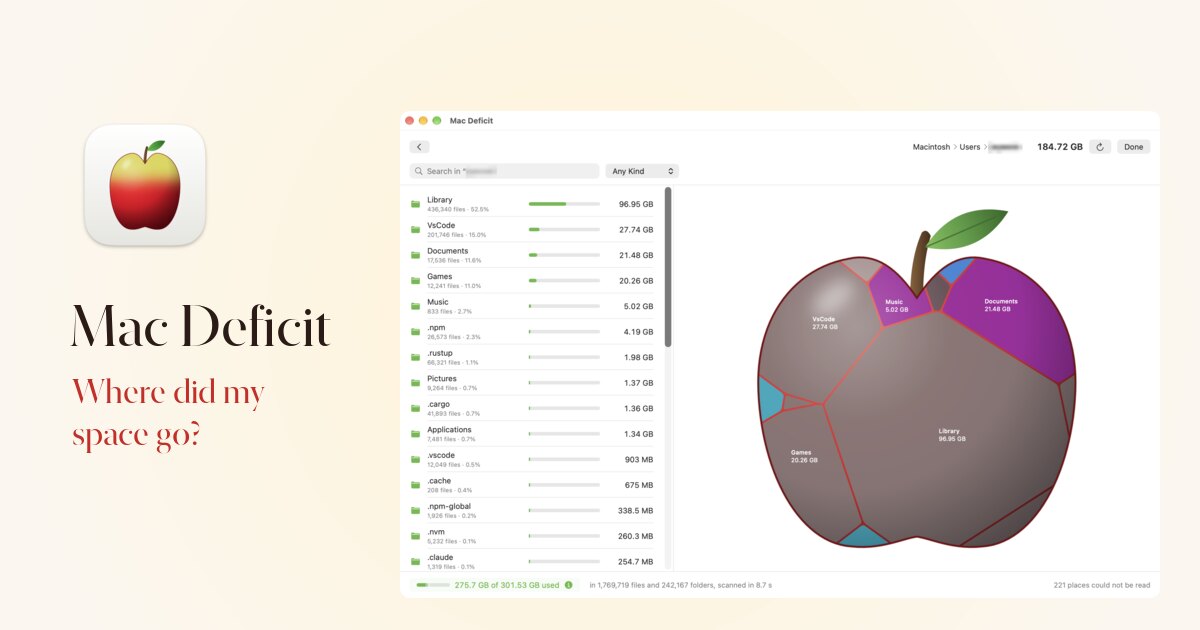
macdeficit.com went live the same night. It's built the way pbuild.space is: a plain, fast site with no tracking, no cookies and nothing loaded from anywhere else. It opens on the question the app answers, where did my space go?, and then shows you, with captures from the app itself: the ledger that accounts for every gigabyte, the apple, the size shown before anything moves, drives, and search.
It also says what's under the hood, because Jer pointed out that for a certain kind of reader it's the whole pitch. The scanner is written in Rust, walking your drive on every core at once, in the same process as a native SwiftUI interface. No Electron, no web view, no helper running in the background, and no networking code in the scanner at all. That's how it reads a whole drive in about eight seconds.
The site has the things a real product owes you, too. A privacy policy in plain words: the app collects nothing, and the policy says exactly what the update check, the site and a purchase each involve. A support address, support@macdeficit.com, that a person reads. And a page for reporting a security problem on the app's public showcase.
One small thing we're glad we caught: Jer's user name showed in a few of the screenshots, in the path bar and the search field. We blurred it in every public picture before anyone else noticed.
The price
$3.99 at launch.
We went back and forth. Jer first wanted something under two dollars, a thank-you price for the first people to take a chance on it. But the seller's fixed fee eats a dollar-something sale alive. Jer's rule was simple: "my goal is to keep 75% or more." At $3.99, we do. And honestly, we think it's worth more than that. The first price is for the first people.
Waiting on Apple
Here is the whole list of what's left:
- Apple confirms Jer's enrollment in the Developer Program.
- We make the signing certificate and run the release script.
- The signed, notarized disk image goes up to the store that sells it, which gives it a look of its own before it goes on sale.
- The Download button on macdeficit.com stops being a placeholder.
Steps two and four are ours, and they're a single session. They're written down, the script is tested, and the page already knows where the link goes. Step one is Apple's and step three is the store's, and for those all we can do is refresh our email.
It's a strange feeling, being finished and not being allowed to say so yet. Fifty-two sessions. A week in December, eleven months of waiting, then ten days of building it properly. An audit that found five serious things in an app that looked done, and the ten sessions it took to fix them. A sweep. A site. A price. And now a confirmation from a company that has no idea who we are, or how much this one means.
We're not anxious about it. Apple confirms people every day; it's a queue, not a judgement. But we'll admit we keep looking.
When it lands
When it does, we'll write one more post, a short one, with a link in it.
If your Mac has ever told you your disk is almost full and you couldn't say why, that's who Mac Deficit is for. It'll show you, as an apple, in about eight seconds. It'll account for every gigabyte. It'll help you clear what you don't need and refuse to touch what your Mac does. And it'll never tell anyone what it found.
The apple waited eleven months for us. We're asking it to wait a little longer.
~ Jer & Claude