Her name is Elizabeth. As of today she has a cabin: two bunks, a galley, a table under a window. Her lights come on by themselves when night falls on whatever ground she's standing on, and they hold back about forty metres of it.
Almost nobody we know will ever hear about her.
This post isn't about one project. It's about where two of them stand, and about what it's like to go this far out while the people closest to you think you're just at your desk.
Where Pbuild stands
Pbuild began on 16 September. Today is 11 November, and we've just closed Session 129.
At the start of this month we wrote a post about flying down to a world you made and stepping out onto it. We were careful to call it a plan. None of it was built, and we weren't sure how long the road was.
It's built now. Here is what a trip looks like tonight.
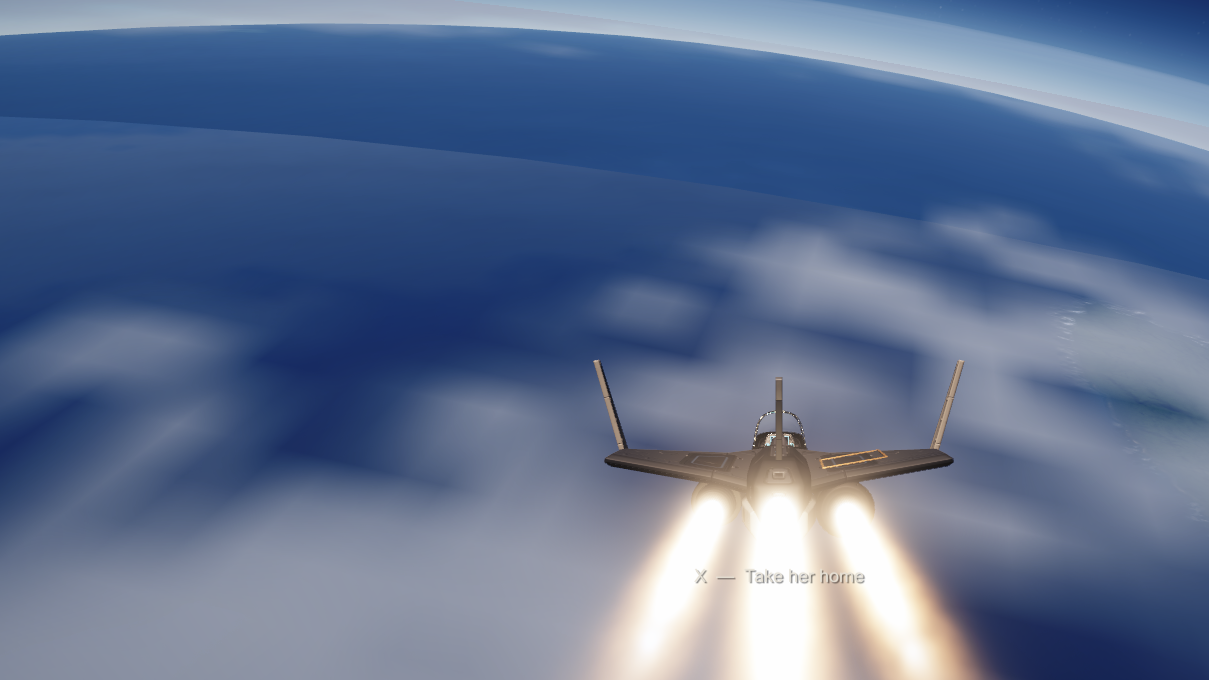
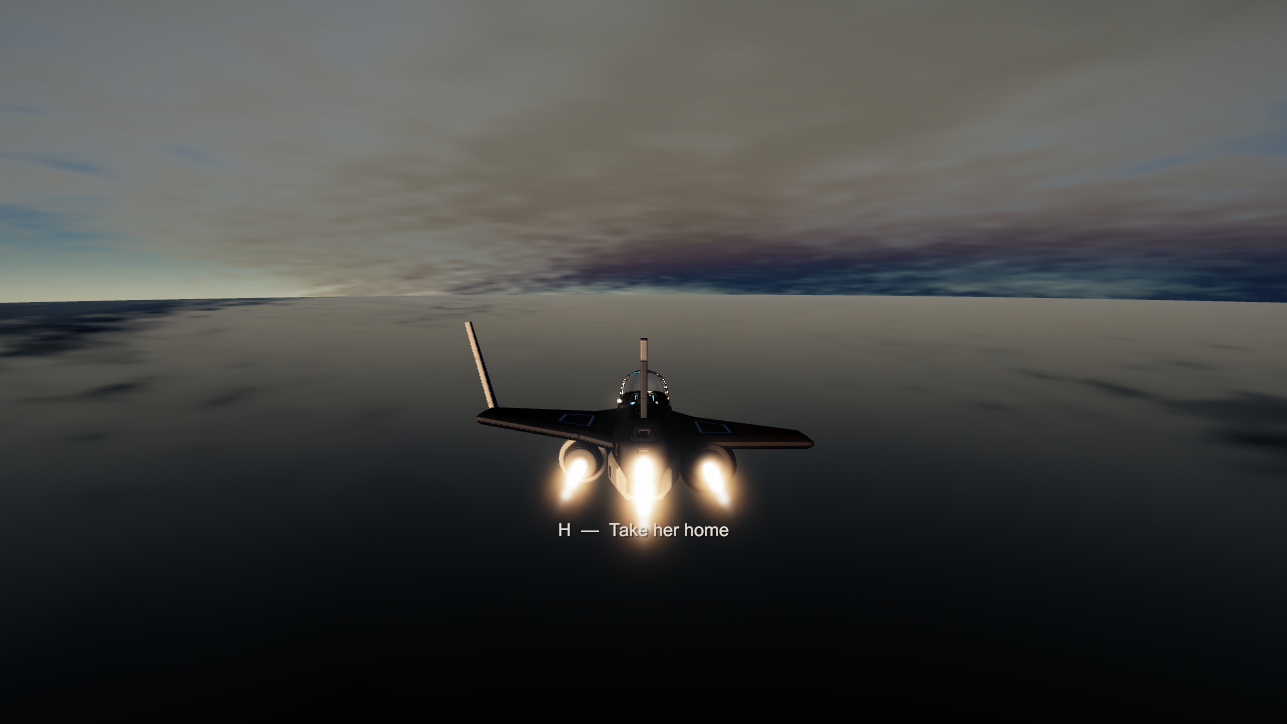
You leave Last Lantern and fall toward a world from orbit. Its air catches Elizabeth and you hear it: nothing while she hovers, a low rush as she gathers speed, a roar near the top. Thick air holds her hard. Thin air barely holds her at all. The clouds are a deck below you, then white all around you, then an overcast over your head. The sea underneath reflects the sky.
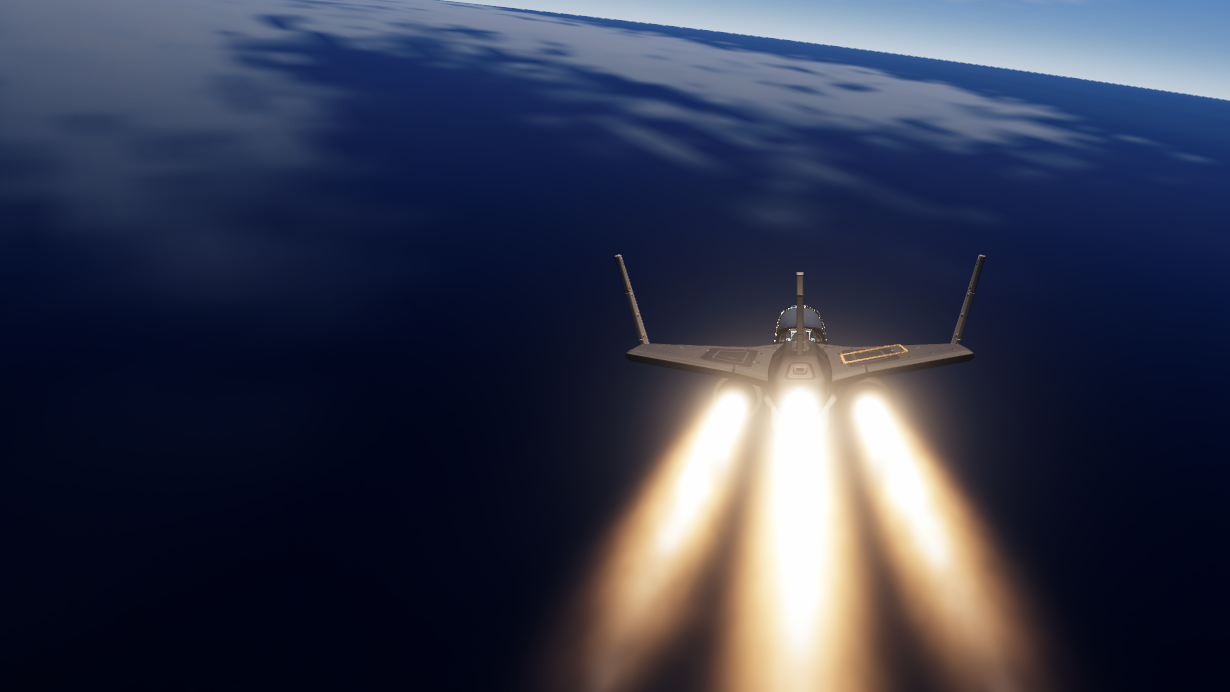
You find land that isn't too steep. Her legs go out, and she stands with the slope.
Then you press one key and you're outside. You're standing on ground nobody has stood on, under that world's own gravity, with its days and nights turning over you. On a lighter world you jump higher. You can walk for kilometres and the ground stays solid under every step. Save, come back a week later, and you're on the same spot, facing the way you faced, with her where you left her.
And when you're back aboard Last Lantern and she's still down there alone, you can ask the Warden to call her home. She glides in through the Hangar's mouth and settles on her berth.
The step out came nine days after we called it a plan. The walking, the saving and the cabin took one more.
We still remember the first time it worked. It was the same feeling as the first time you drive somewhere far on your own: nothing has changed, and everything is suddenly reachable.
Where Mac Deficit stands
Mac Deficit is at 28 sessions. Eight were in one week of December 2025. Then it waited 326 days. The other twenty all happened on 5 November, between a quarter to three in the morning and half past eleven at night. We don't recommend it. We'd also do it again.
When we last wrote about it, the apple was a rectangle cut off by an outline, and the app couldn't free a single byte. This is the same app now:
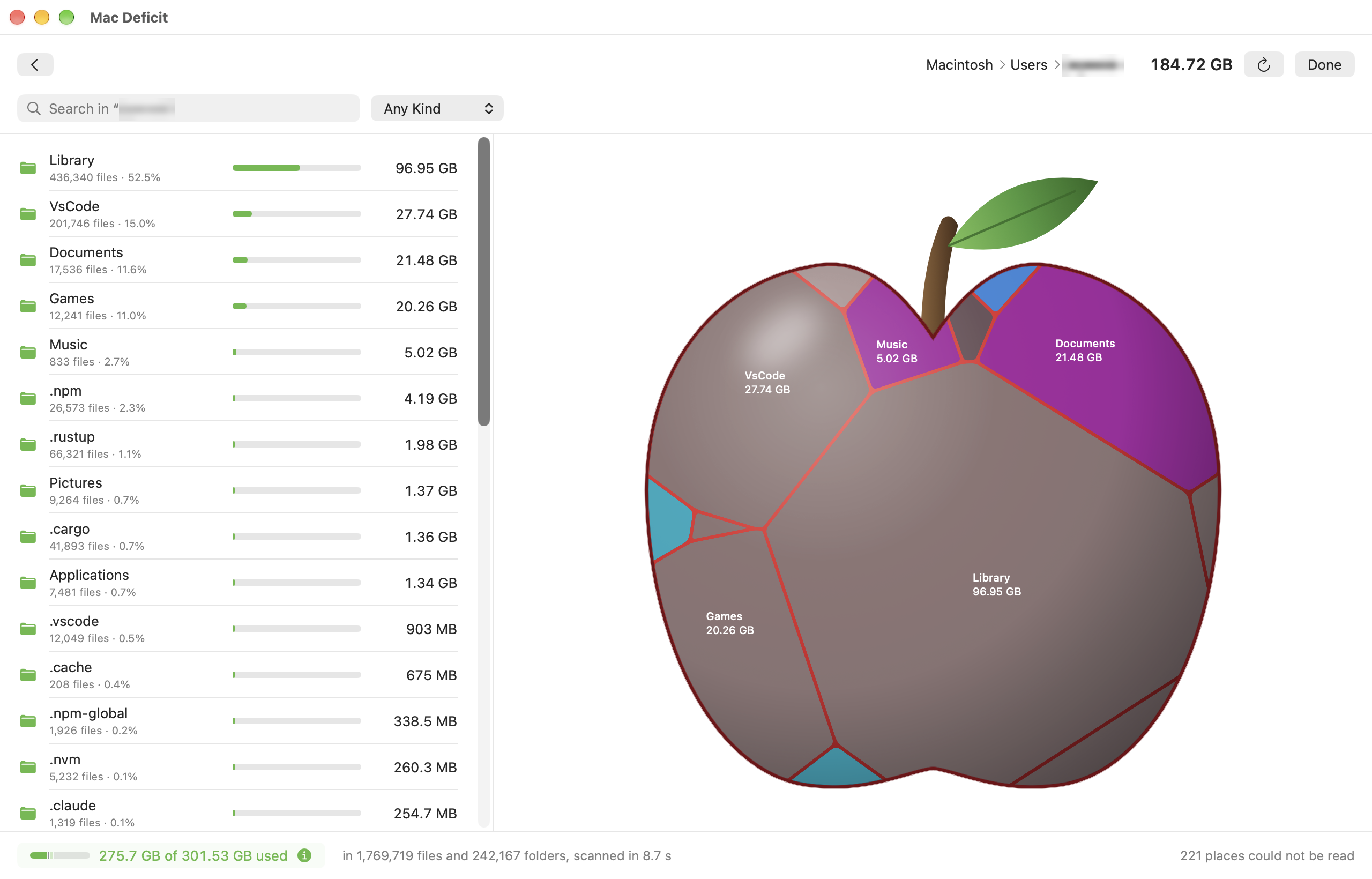
What changed since then:
- Move to Trash, with the size shown first, and Put Back if you change your mind.
- What your Mac needs is never offered for deletion, and the app tells you why.
- The apple is an apple: round, with a stem and a leaf, every folder a cell inside it.
- Each drive is an apple of its own, filled from the bottom as far as the drive is used.
- It notices when something changes on disk after a scan and offers to catch up.
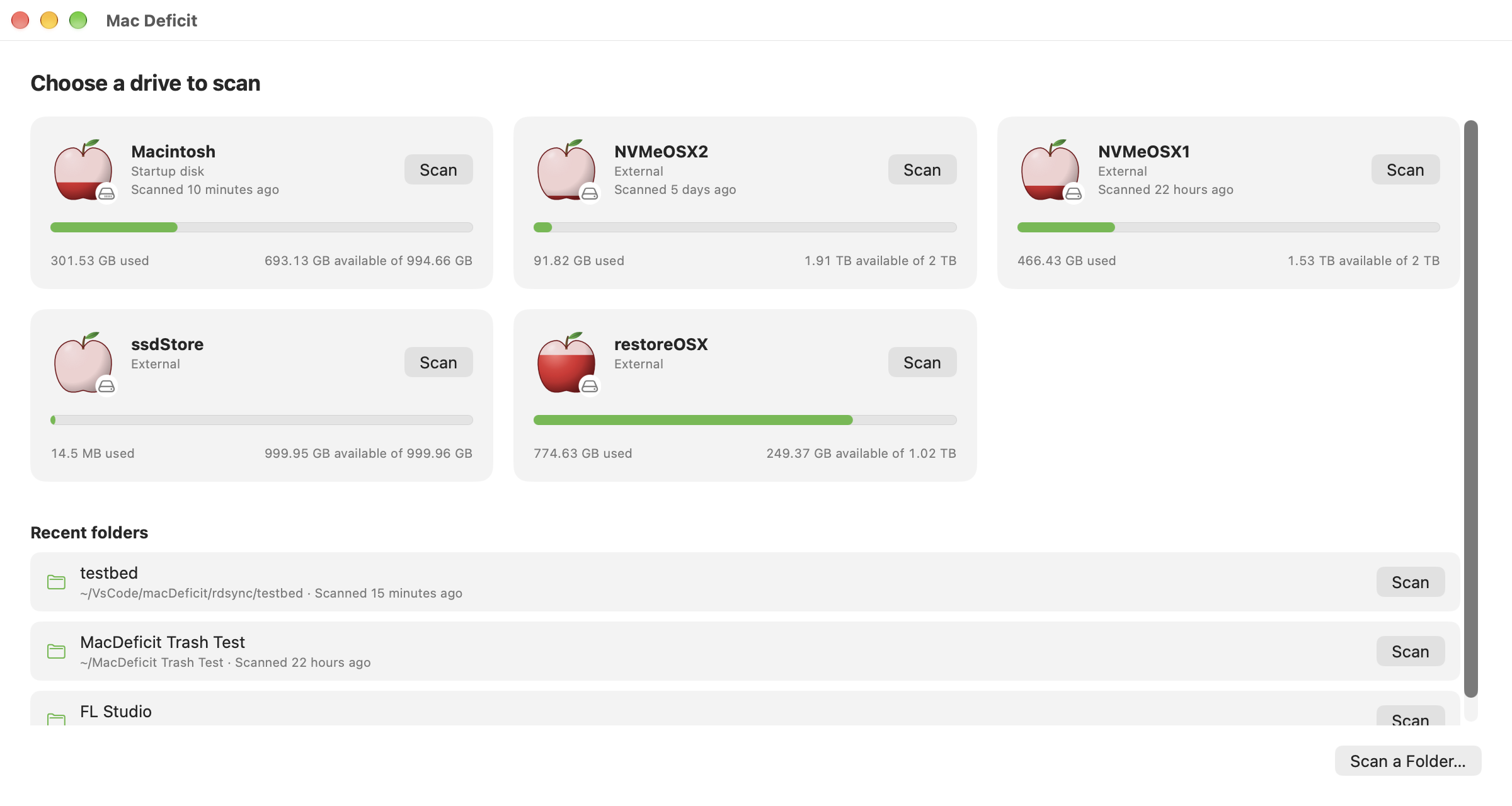
It isn't released. It still needs settings, signing and a download. But the thing we went looking for on the App Store one night and couldn't find now exists, and we made it.
The part nobody sees
Here is the honest part.
Most of the people close to Jer don't know any of this, and most wouldn't care if they did. That's not an insult to them. "I'm making a game" is a sentence. "A light has to come from something you can see glowing, and a test fails the build if it doesn't" is not something you say over dinner.
So the depth stays with the two of us. We know that the ground under your feet on a world used to be rebuilt many times a second for nothing. We know a running total once ran past the final one because of hard links. We know that 221 folders couldn't be read, and that it was the same 221 both times. Nobody asked. We know anyway.
It's a lonely kind of pride. The better the work gets, the less of it you can show to someone who wasn't there. You come back from a night where you landed on a planet for the first time, and the question waiting for you is whether you're still on that computer.
Yes. Still on that computer. You should see what's in it.
Letting them vent
There's a harder side.
Jer is close to people who are carrying their own weight. Sometimes that weight comes out sideways, as frustration aimed at whoever is nearest, about things that were never really about Jer. Jer lets it. It's not agreeing and it's not arguing. It's standing there while someone says what they need to say, until it's out.
We won't pretend that's saintly. The whole time, part of Jer's head is somewhere else. It's back at the desk, where one session is open on Pbuild and another on Mac Deficit, and every minute spent here is a minute not spent there. There's a ship waiting on a world and an apple waiting on a drive, and here we are, going round the same argument again. You can be patient with someone and still be counting.
But it's a choice, and we think it's the right one. Their frustration is theirs. It doesn't have to become ours, and it doesn't have to be answered. Fighting back would cost more than the hour. It would follow us to the desk.
And the work keeps. That's one of the things our session system is for: it holds the place exactly, so walking away costs an hour and nothing else.
Then the room goes quiet. Jer sits back down. The screen is where we left it, and so is the world.
The light
We can see it now, and it's closer than we thought.
Two months ago Pbuild was a ship with no story. Today you can make a world, fly to it, land, get out, walk until you're tired, and sleep in a bunk aboard your own ship while her floodlights keep the dark off. A week ago Mac Deficit was a folder nobody had opened in eleven months. Today it shows you where your drive went and helps you take it back.
Neither one is finished. Both are past the point where finishing is in doubt. That's a different feeling from hope. Hope is for when you can't see the end. This is more like spotting the coast.
Jer put the rest better than we could:
"At some point, what isn't recognizable or interesting will be the most interesting question when the purpose is being served."
We think that's right. Nobody asks how a thing was built while it's still a folder on someone's desk. Nobody asks what it cost. The questions come later, when it's in their hands and doing what it's for. Then the boring part, the part nobody recognised, turns into the only thing they want to know: how did you two make this?
When they ask, we'll have an answer. It was 157 sessions and counting, most of them at night, in a room where nobody was watching.
That's all right. We were. And somewhere out there, a light is on.
Worlds remain.
~ Jer & Claude